Knock out the mold, bacteria, and musty odors hiding in your ductwork with an EPA-registered antimicrobial fog that reaches every inch the vacuum can't.
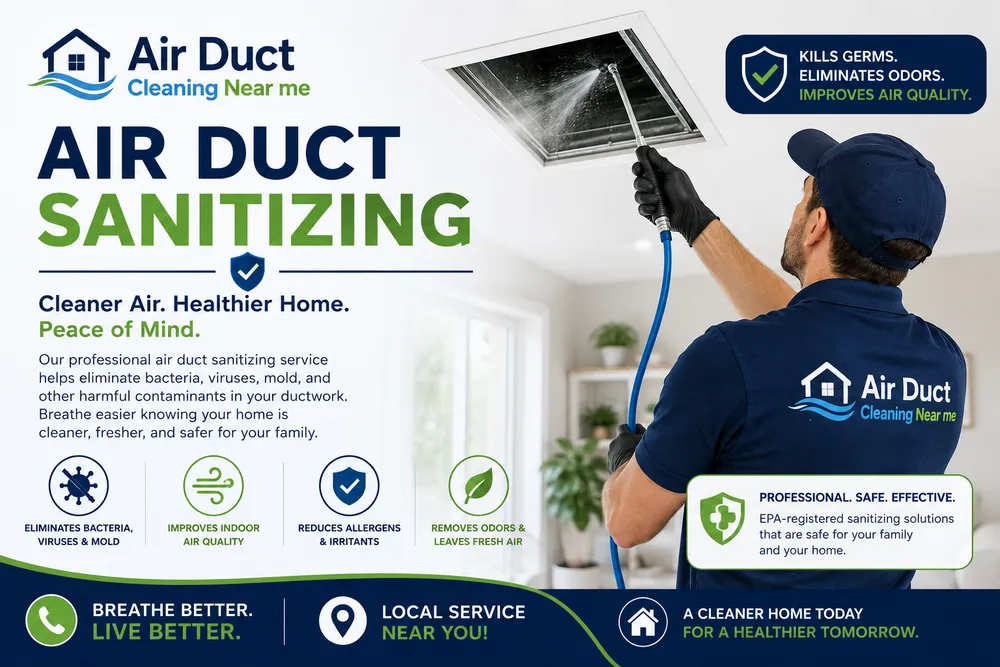
Air duct sanitizing is the step that turns a clean duct system into a healthy one. Where a standard cleaning removes the visible dust, debris, and buildup that collect inside your ductwork, sanitizing goes after what you can't see: the mold spores, bacteria, mildew, and lingering odors that survive a vacuum and keep recirculating through every room. Through Air Duct Cleaning Near Me, you're connected with vetted, local air duct sanitizing specialists who use EPA-registered antimicrobial treatments to neutralize biological contaminants at the source — and you get upfront pricing plus any negotiated coupons we've secured in your area before a technician ever sets foot in your home. We're a nationwide network headquartered in Austin, TX, not a single shop, which means a qualified air duct sanitizing specialist near you is reachable wherever you are, from Phoenix to Pittsburgh to Tampa. If your home smells musty after the AC kicks on, if anyone in the household has been fighting unexplained allergy flare-ups, or if you've recently dealt with water intrusion or a pest problem, sanitizing is the targeted treatment that addresses the root cause rather than masking the symptom.
It's a common point of confusion, and the distinction matters when you're deciding what to book. Air duct cleaning is a mechanical process — agitation brushes, compressed air whips, and high-powered negative-air vacuums dislodge and capture the dust, pet dander, construction debris, and dead insects that accumulate on duct walls over years of use. Air duct sanitizing is a chemical and biological process that happens after the system is clean: an EPA-registered antimicrobial agent is applied throughout the ductwork to kill the mold, mildew, bacteria, and germs that mechanical cleaning alone leaves behind.
Think of it the way you'd think about wiping a countertop versus disinfecting it. You can remove every crumb and still have an invisible film of bacteria. Sanitizing your ducts treats the interior surfaces so that the air pulled across them — and pushed into your living space — isn't carrying a fresh dose of microbial contaminants on every cycle. This is why sanitizing is most effective when paired with a thorough cleaning first; applying antimicrobial product over a layer of caked dust simply coats the dirt instead of treating the metal and fiberglass beneath it.
Reputable technicians follow guidance from the National Air Duct Cleaners Association (NADCA) and use products applied according to their EPA registration. A real specialist will tell you that sanitizing is a complement to cleaning, not a substitute for it — anyone selling sanitizing as a standalone fix for filthy ducts is cutting corners. If you're starting from scratch, you may want to pair this service with residential air duct cleaning so the antimicrobial treatment actually reaches bare duct surfaces.
Sanitizing isn't something every home needs on a fixed schedule the way a furnace filter does — it's a targeted response to specific conditions. Here are the signals that your duct system is harboring biological contaminants and would benefit from antimicrobial treatment:
Every technician in our network follows a methodical, results-driven sequence so the antimicrobial treatment actually does its job rather than just leaving a pleasant scent. Here's what a professional air duct sanitizing visit looks like:
A trustworthy air duct sanitizing service uses only antimicrobial agents that carry an EPA registration for use inside HVAC systems, applied strictly within their labeled instructions. These products are formulated to kill mold, mildew, and bacteria while being safe for occupied homes once the treatment has dried and the system is cycled. If a provider can't name the product or show its registration, that's a reason to keep looking — and another reason to book through a vetted network.
For a typical single-family home, sanitizing adds roughly one to two hours on top of a cleaning, depending on the size of the system and the number of supply and return runs. Larger homes, multi-zone systems, and commercial buildings take longer. Your technician will give you a realistic time window during the upfront quote so there are no surprises on the day of service.
Pricing for air duct sanitizing depends on the size of your home, the number of supply and return vents, the complexity of the system, and whether it's bundled with a full cleaning. Because sanitizing is most effective right after a cleaning, most homeowners book the two together — and that bundle is almost always more economical than treating them as separate visits on separate days.
Rather than publish a one-size-fits-all number that won't match your actual home, our network gives you an upfront, itemized quote before any work begins. The air duct sanitizing near me specialist assigned to you will assess your system and explain exactly what's included, so the price you're quoted is the price you pay. We also pass along any negotiated deals or coupons we've arranged with providers in your metro — savings you wouldn't find calling a single company cold.
Be cautious of suspiciously cheap whole-home offers. Aggressive low-ball pricing is the calling card of operators who fog a deodorizer through your vents, call it sanitizing, and skip the cleaning and inspection that make the treatment work. A fair quote reflects genuine antimicrobial product, the labor to apply it correctly, and an honest inspection. If the technician finds damage during that inspection, you can address it with air duct repair before sealing problems behind treated walls.
When sanitizing is done properly, the payoff goes well beyond a fresher-smelling home. Because your ductwork touches every room, treating it has a whole-house effect that surface cleaning can't match:
Unlike routine duct cleaning, which many households schedule every three to five years, sanitizing is condition-driven. You sanitize when there's a reason to — visible mold, a musty odor, a moisture event, a pest problem, or a respiratory concern in the home. For most families with a dry, well-maintained system and no symptoms, sanitizing on every cleaning isn't necessary.
That said, certain environments call for more frequent treatment. Homes in humid climates — much of the Southeast, the Gulf Coast, and coastal regions — are far more prone to mold growth inside ductwork, so households in places like Houston, New Orleans, or Miami may benefit from sanitizing on a more regular basis. The same goes for homes with chronic high humidity, residents who are immunocompromised, or buildings that have had repeated water issues.
The honest answer is that a good technician won't push sanitizing if your system doesn't need it. During the inspection, your specialist will tell you whether antimicrobial treatment is warranted now or whether maintaining a clean, dry system through periodic HVAC cleaning is the smarter move for your situation. Pairing sanitizing with a UV air purifier installation is also worth discussing, since UV light continuously suppresses microbial growth in the air handler between treatments.
Air duct sanitizing applies to far more than single-family homes. The same antimicrobial process protects apartments, condos, offices, medical and dental practices, restaurants, schools, and other facilities where indoor air quality directly affects occupants. The difference is scale and system complexity — commercial buildings often run multiple zones, larger duct trunks, and rooftop units that demand specialized equipment and scheduling around business hours.
For property managers and business owners, sanitizing is frequently part of a broader indoor-air-quality program and may be driven by tenant health complaints, lease requirements, or post-incident remediation. Our network includes specialists experienced with commercial air duct cleaning and large-scale antimicrobial treatment, so a clinic in Denver and a warehouse in Atlanta can both get the right crew. While you're scheduling, it's worth asking the technician to check the laundry exhaust too, since clogged lines are a fire hazard — dryer vent cleaning is a quick add-on that many homeowners handle on the same visit.
Searching "air duct sanitizing near me" returns a wall of listings with no easy way to tell the careful operators from the bait-and-switch outfits. That's the problem our network was built to solve. We don't perform the work ourselves — we vet and connect you with local air duct sanitizing specialists who use EPA-registered products, follow NADCA-aligned methods, and quote honest, upfront pricing.
Because we operate nationwide from our Austin, TX headquarters and aren't tied to any single market, we negotiate deals with quality providers and pass those coupons straight to you. You get the convenience of one trusted point of contact and the confidence that the technician arriving at your door has already cleared our screening — no cold-calling strangers, no guessing whether the low price hides a low standard.
Whatever brought you here — a musty smell, an allergy flare-up, or a recent leak — there's a qualified specialist near you ready to help. If your inspection reveals dust buildup that hasn't been touched in years, the same crew can handle the underlying cleaning, and if you're considering longer-term air-quality upgrades, ask about an air duct inspection to map out exactly what your system needs.
Booking takes minutes. The results last for years.
Tell us your home size and number of vents to get a flat, no-surprise quote. Pick a same-day or next-day slot with a vetted local technician trained in antimicrobial duct treatment.
After clearing loose debris, your tech applies a fine antimicrobial mist that coats the interior duct surfaces, attacking the mold spores, bacteria, and odor-causing buildup a standard vacuum leaves behind.
The treatment neutralizes musty smells at the source and leaves your ductwork sanitized, so the air circulating through every room comes out cleaner. You get a clear summary of exactly what was treated.
Real reviews from our network — verified across Google and Yelp.
"Our HVAC system had a persistent musty smell whenever it turned on. After the cleaning and sanitization service, the odor completely disappeared. The technician was courteous and clearly experienced. Highly recommended."

"We hadn't cleaned our air ducts since purchasing the home nearly ten years ago. The technician showed us photos of the buildup inside the vents and thoroughly cleaned the entire system. We also added vent sanitization. Great service and very professional."

"Our family suffers from seasonal allergies, and we decided to have the ducts professionally cleaned. Air Duct Cleaning Near Me helped us find a great local company. The improvement has been amazing. There is less dust in the house, and the air feels much cleaner."
Mention any current coupon when you request your free quote and we'll connect you with a trusted local technician near you.
Get my free quote →Tell us about your home and we will send a free, no-obligation quote — usually the same day. Prefer to talk? Call (888) 328-1898.